Time & finance / Retainer tracking
Make the remaining hours easy to see.
A focused workspace for recording client work against agreed retainers and reviewing overages before the next conversation.
The everyday friction
Where work gets
disconnected.
Retainer balances depend on a spreadsheet somebody updates later.
Small pieces of work accumulate without clear context.
Overage conversations arrive after the work is already done.
An illustrative workflow
Retainer tracking
in practice.
No invented customer results. This example shows the process to discuss.
Open the full walkthrough ↗The consultant records work against a monthly allowance.
The dashboard shows used and remaining hours.
An overage is reviewed with its supporting entries.
The next month’s allowance becomes a clear client conversation.
Capability catalogue
The details behind
the workflow.
The following capabilities were identified in the existing source system. Your proposal defines the included edition, configuration and tested integrations.
Time model
- Project records
- Time entries
- Running timer model
- Monthly project-hour view
- Retainer cap and rate configuration
Dashboard
- Overview
- Email task triage
- Billable tagging
- Completion tracking
- Retainer report view
Reporting and connections
- Cap-versus-actual reporting
- Overage hours and value
- Effective rate
- Monthly report tooling
- Asana write-back code
- Asana app scaffold
See the shape of it
A clearer conversation
starts with context.
The source contains project/time records and cap-versus-actual reporting; multi-client generalisation is part of implementation.
View the illustrative workflow ↗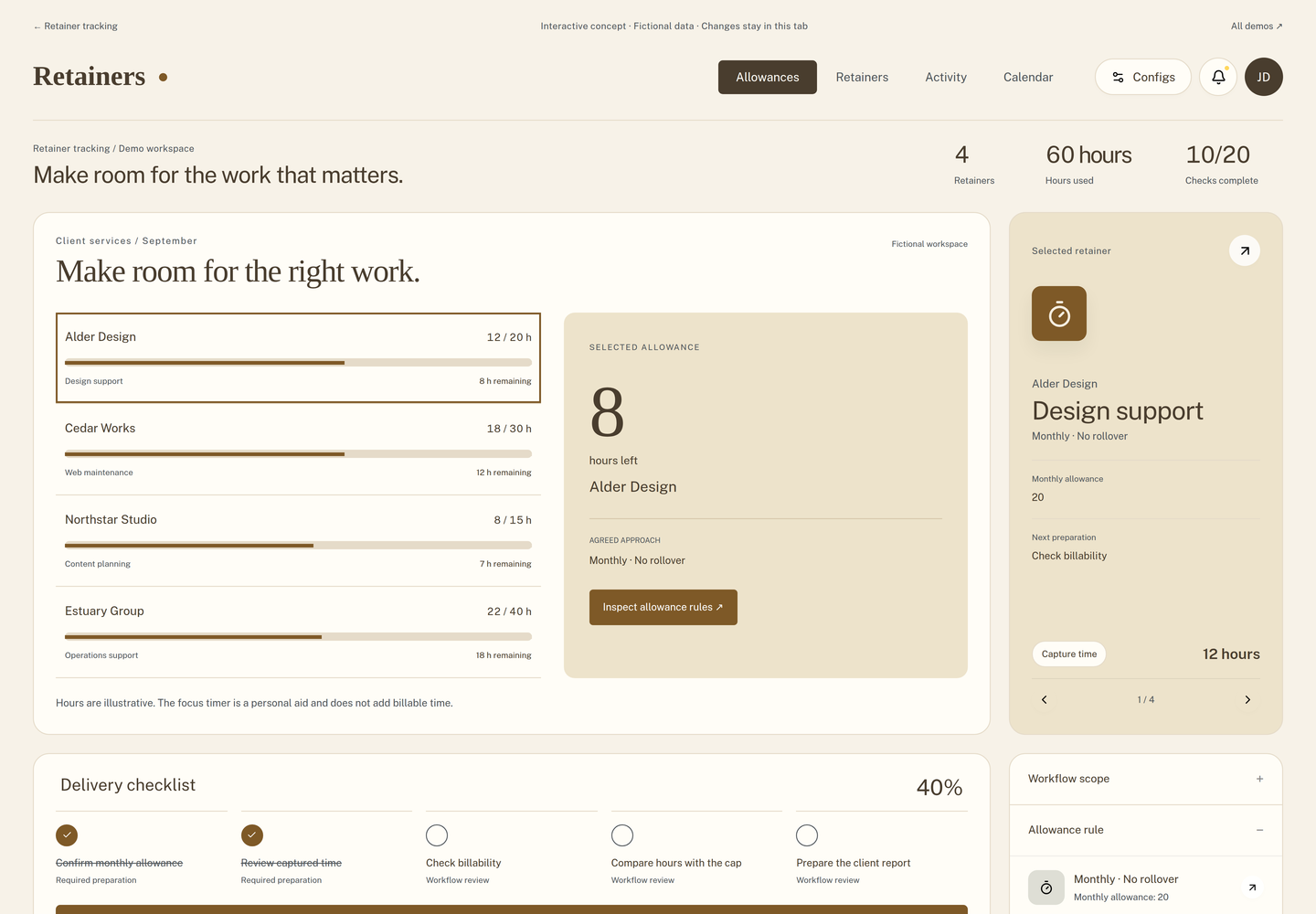
Implementation & fit
Define your version
before rollout.
Rollover rules, rounding, billing and client visibility are agreed for your retainer model.
When another tool may be a better fit
Teams needing broad workforce scheduling, payroll or complex project portfolio management.
Useful success measures
- Hours captured
- Retainer overage visibility
- Unassigned time
- Report preparation time
Measures to agree and establish a baseline for; no performance result is promised.
Common questions
Before we talk.
Can I sign up and use every feature immediately?
These are configured implementations. We first agree the edition, scope and required integrations. The catalogue describes source capabilities, rather than an instant subscription entitlement.
Can this use my branding?
Branding, domain, user access and customer data boundaries can form part of the implementation brief. We confirm what is supported and test it for the agreed edition.
What should I bring to the first conversation?
Do unused hours expire, roll over or convert into another allowance? A short description is enough to begin; please do not send customer records or credentials.