Bookings & operations / Fuel delivery operations
A clearer path from delivery request to approved invoice.
Connect customer requests, dispatch, driver records, price snapshots and manager review for a small fuel-delivery operation.
The everyday friction
Where work gets
disconnected.
Dispatch and drivers work from different versions of the job.
Delivered quantities need to be reconciled with the invoice.
Price changes and approvals create avoidable billing questions.
An illustrative workflow
Fuel delivery operations
in practice.
No invented customer results. This example shows the process to discuss.
Open the full walkthrough ↗A customer requests a delivery and the dispatcher assigns the job.
The driver records a load and the delivered quantity.
The relevant price is captured with the invoice submission.
A manager reviews the invoice before the customer sees it.
Capability catalogue
The details behind
the workflow.
The following capabilities were identified in the existing source system. Your proposal defines the included edition, configuration and tested integrations.
Customer management
- Client and customer screens
- New delivery booking
- Customer portal routes
- Driver customer lookup
- Token invoice view
Dispatch and fleet
- Dispatch screen
- Jobs endpoints
- Truck management
- Employee roles
- Driver delivery entry
- Fuel load records
Pricing and invoicing
- Daily fuel prices
- Price snapshot on invoice submission
- Approval and rejection
- Invoice resend
- Manual paid status
- Zelle payment instructions
Driver tools
- Mobile load entry
- Receipt image extraction handler
- Customer selection
- Quantity and total entry
- Submit-for-approval workflow
Platform
- Supabase authentication
- Administrator and driver surfaces
- Resend email adapter
- Fuel-cost schema
- Public booking page
See the shape of it
A clearer conversation
starts with context.
The source contains delivery, load-entry, pricing and approval surfaces.
View the illustrative workflow ↗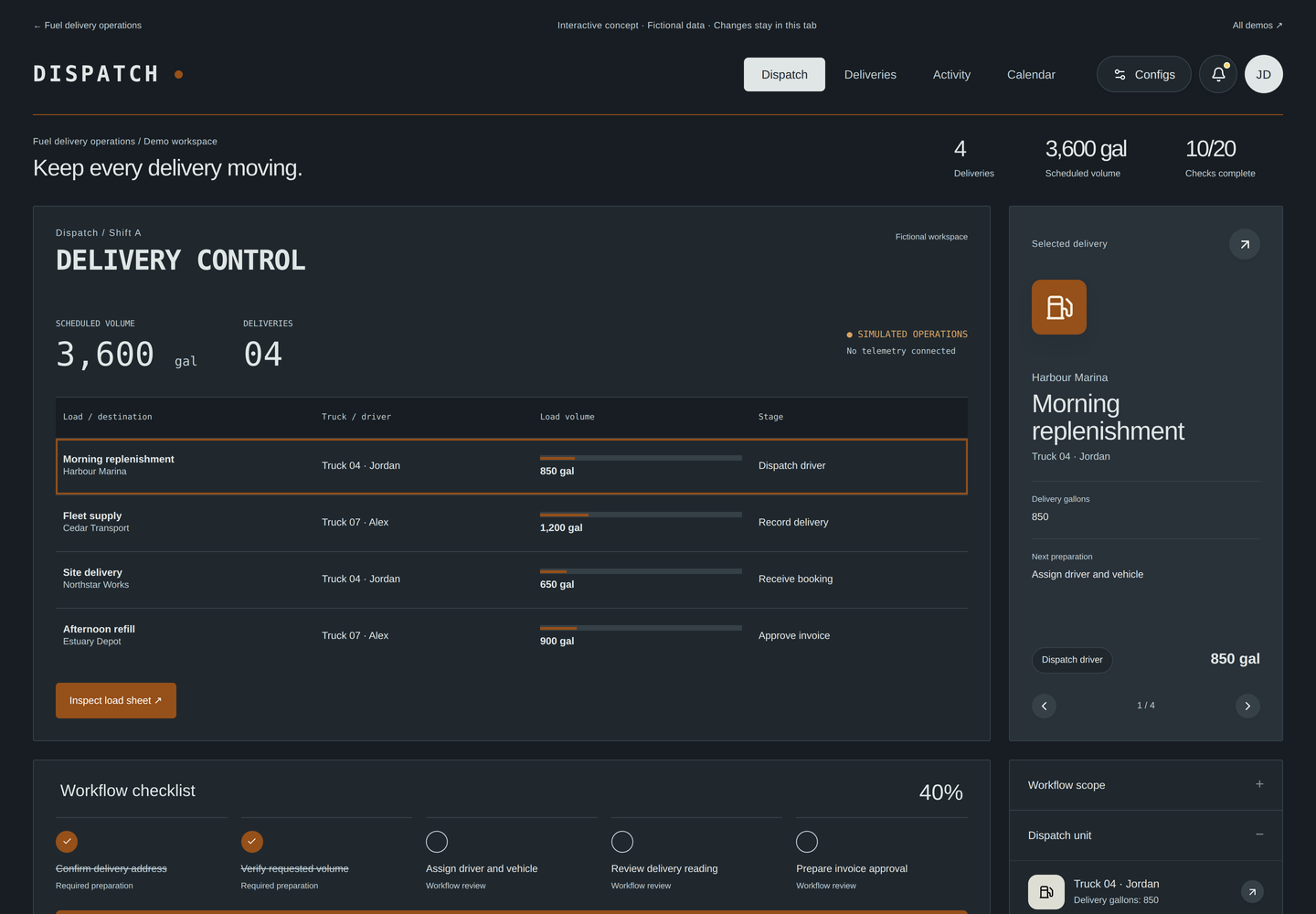
Implementation & fit
Define your version
before rollout.
Meters, tank telemetry, routing, jurisdictional taxes and payment providers require separate assessment.
When another tool may be a better fit
A fleet needing immediate tank-monitor hardware, automated forecasting or native route optimisation.
Useful success measures
- Delivery-to-invoice time
- Rejected delivery records
- Unpaid approved invoices
- Load-versus-delivery variance
Measures to agree and establish a baseline for; no performance result is promised.
Common questions
Before we talk.
Can I sign up and use every feature immediately?
These are configured implementations. We first agree the edition, scope and required integrations. The catalogue describes source capabilities, rather than an instant subscription entitlement.
Can this use my branding?
Branding, domain, user access and customer data boundaries can form part of the implementation brief. We confirm what is supported and test it for the agreed edition.
What should I bring to the first conversation?
How do drivers currently record quantities and hand completed deliveries to billing? A short description is enough to begin; please do not send customer records or credentials.